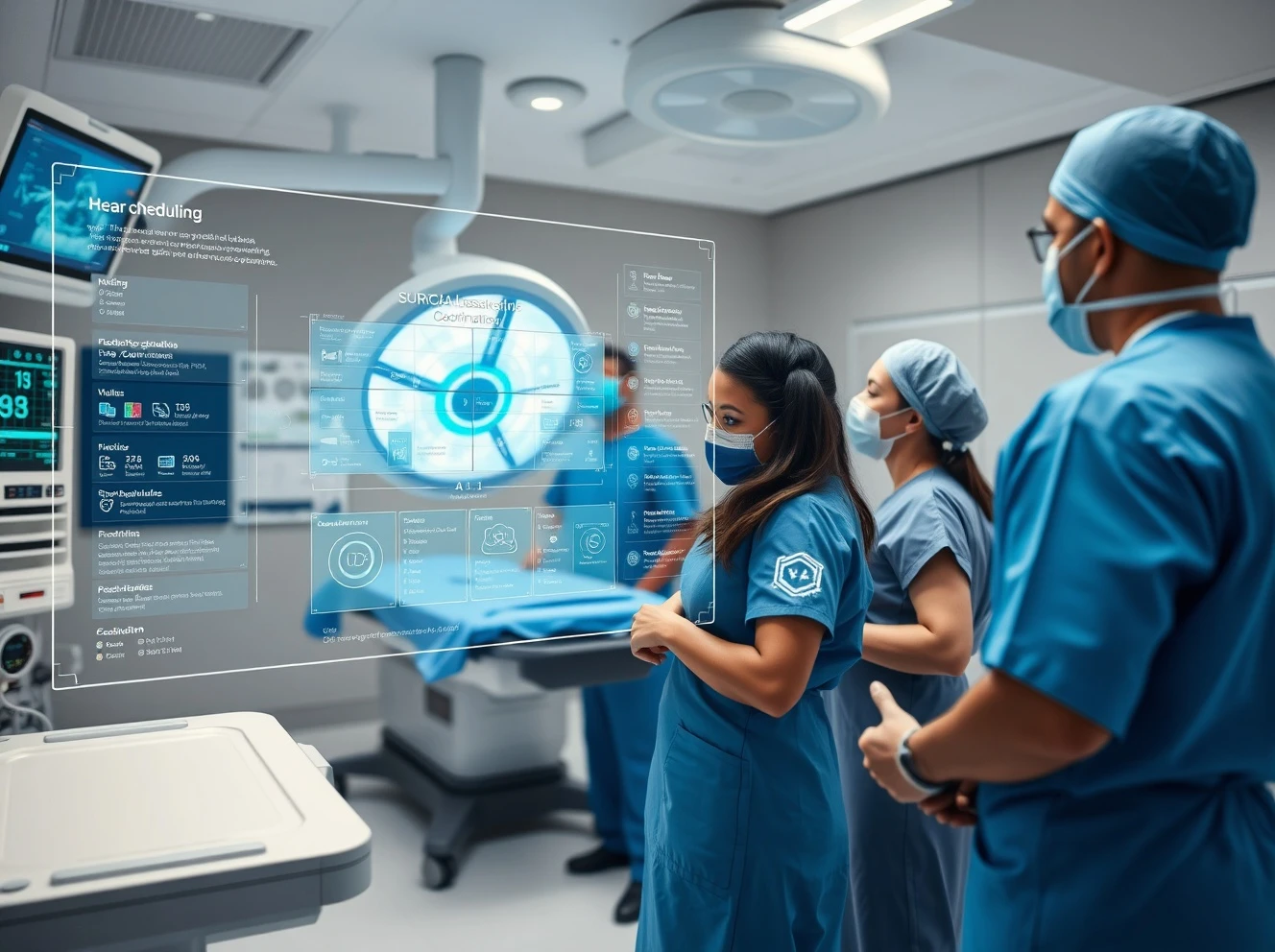
In hospitals across the United States, a silent crisis drains millions from healthcare budgets daily—not from complex surgeries or expensive equipment, but from the chaotic coordination between operations. This AI operating room innovation promises to reclaim lost time and resources through intelligent scheduling systems that could transform surgical workflows by 2025.
The Hidden Cost of Operating Room Inefficiency
Operating rooms represent the financial engine of modern hospitals. Consequently, their efficient operation directly impacts institutional viability. Research from the American Hospital Association reveals that surgical departments generate approximately 70% of hospital revenue. However, between two and four hours of valuable OR time disappear daily due to coordination failures. These losses stem from multiple factors including manual scheduling errors, equipment misplacement, and staff miscommunication.
Traditional scheduling systems rely heavily on human judgment and paper-based tracking. As a result, they often fail to account for numerous variables simultaneously. These variables include surgeon availability, equipment sterilization cycles, nursing staff rotations, and patient preparation timelines. Furthermore, emergency cases frequently disrupt carefully planned schedules, creating cascading delays throughout the surgical day.
How AI Transforms Surgical Coordination
The emerging solution utilizes artificial intelligence to analyze historical data and predict optimal scheduling patterns. Specifically, machine learning algorithms process thousands of data points from previous surgeries. These data points include procedure duration, equipment usage, staff performance metrics, and patient recovery times. Subsequently, the system generates dynamic schedules that adapt in real-time to changing conditions.
The Startup’s Innovative Approach
One healthcare technology startup has developed a proprietary platform that addresses these coordination challenges comprehensively. Their system integrates with existing hospital electronic health records and resource management software. Importantly, it employs natural language processing to interpret surgical notes and preference cards automatically. This automation reduces manual data entry errors significantly.
The platform’s predictive capabilities extend beyond basic scheduling. For instance, it forecasts equipment maintenance needs based on usage patterns. Additionally, it optimizes staff assignments according to individual skill sets and historical performance data. These features collectively minimize downtime between procedures while maintaining surgical quality standards.
Real-World Implementation and Results
Early adopters report measurable improvements in operating room utilization. A midwestern hospital system implemented the technology across eight surgical suites last year. Their data shows a 22% reduction in turnover time between procedures. Moreover, they achieved a 17% increase in daily surgical volume without extending operating hours. These improvements translated to approximately $3.2 million in additional annual revenue.
The system’s impact extends beyond financial metrics. Operating room staff report decreased stress levels due to clearer communication channels. Surgeons appreciate more predictable schedules that respect their time constraints. Patients benefit from reduced preoperative waiting periods and more consistent surgical start times.
| Metric | Traditional System | AI-Optimized System | Improvement |
|---|---|---|---|
| Average Turnover Time | 42 minutes | 32 minutes | 23.8% reduction |
| Schedule Adherence | 64% | 89% | 25 percentage points |
| Staff Overtime Hours | 18 hours/week | 9 hours/week | 50% reduction |
| Equipment Utilization | 71% | 86% | 15 percentage points |
Technical Architecture and Data Security
The platform employs a hybrid cloud architecture that ensures both performance and security. Patient data remains within hospital firewalls through on-premise processing nodes. Meanwhile, anonymized operational data feeds cloud-based machine learning models. This approach maintains HIPAA compliance while leveraging scalable computational resources.
Encryption protocols protect all data transmissions between system components. Additionally, the platform incorporates blockchain technology for audit trails of schedule changes. These security measures address healthcare institutions’ legitimate concerns about data protection and regulatory compliance.
Expert Perspectives on Surgical AI
Dr. Elena Rodriguez, a healthcare systems researcher at Johns Hopkins University, explains the technology’s significance. “Previous attempts to optimize operating room schedules relied on simplistic algorithms,” she notes. “Modern AI systems consider hundreds of interdependent variables that human planners cannot process simultaneously.”
Healthcare economists highlight the broader implications. The United States spends approximately $400 billion annually on surgical care. Even modest efficiency improvements could save billions while increasing patient access. These savings become particularly crucial as healthcare systems face staffing shortages and financial pressures.
Implementation Challenges and Solutions
Successful adoption requires careful change management strategies. Resistance sometimes emerges from staff accustomed to traditional methods. The startup addresses this through comprehensive training programs and phased implementation schedules. Typically, hospitals begin with a single operating room before expanding system-wide.
Integration with legacy hospital systems presents technical challenges. The platform utilizes standardized healthcare data protocols like HL7 and FHIR. These protocols facilitate communication with diverse electronic medical record systems. Custom interfaces handle institution-specific requirements when necessary.
Key implementation considerations include:
- Staff training requirements: 8-12 hours per user with ongoing support
- Integration timeline: 4-6 weeks for initial operating room
- Data migration: Historical data analysis improves prediction accuracy
- Customization needs: Adaptation to hospital-specific workflows and policies
Future Developments and Industry Trends
The technology continues evolving with several promising directions. Computer vision integration could track instrument usage and staff movements automatically. Predictive analytics might forecast surgical complications based on real-time patient data. These advancements could further enhance both efficiency and patient safety.
Industry analysts project rapid market growth for surgical coordination technologies. The global market for operating room management solutions should exceed $8 billion by 2027. This growth reflects increasing recognition of operational efficiency’s importance in healthcare sustainability.
Conclusion
The AI operating room revolution addresses a critical healthcare challenge through intelligent coordination systems. By reclaiming lost surgical time, these technologies improve hospital finances while enhancing patient care. The startup’s innovative approach demonstrates artificial intelligence’s practical value beyond speculative hype. As healthcare systems adopt such solutions, patients and providers alike stand to benefit from more efficient, predictable surgical experiences.
FAQs
Q1: How does AI scheduling differ from traditional operating room management?
AI systems analyze thousands of historical data points to predict optimal scheduling patterns, considering numerous variables simultaneously that human planners cannot process efficiently. Traditional methods rely on manual coordination and simpler algorithms.
Q2: What data does the system require for effective operation?
The platform utilizes historical surgical duration data, equipment usage records, staff availability patterns, patient preparation timelines, and emergency case statistics. It integrates with existing hospital systems to gather this information automatically.
Q3: How quickly do hospitals typically see results after implementation?
Most institutions observe measurable improvements within 4-8 weeks as the system learns institutional patterns and staff adapt to new workflows. Full optimization typically occurs within 3-6 months.
Q4: Does the AI replace human surgical schedulers?
No, the technology augments human decision-making rather than replacing staff. Schedulers transition from manual coordination tasks to overseeing system recommendations and handling exceptions that require human judgment.
Q5: What are the main barriers to adoption for hospital systems?
Key challenges include integration with legacy systems, staff training requirements, initial implementation costs, and change management. Successful implementations address these through phased rollouts, comprehensive training, and clear communication of benefits.