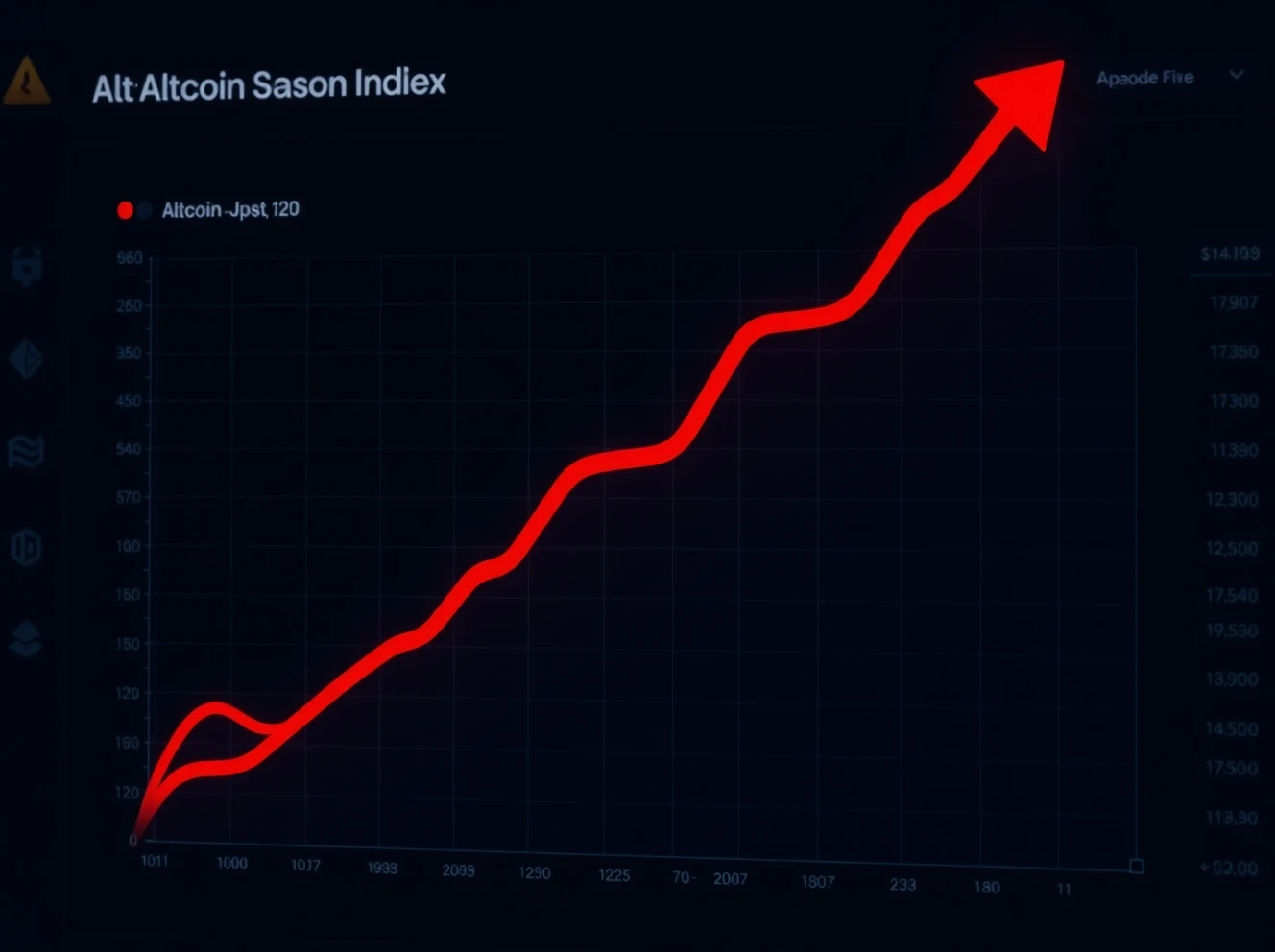
December 26, 2025 – A crucial market indicator just delivered a sobering message for cryptocurrency traders worldwide. The Altcoin Season Index, a widely monitored barometer of market sentiment, has plummeted to a reading of 16. This sharp decline from 17 just yesterday confirms a powerful and sustained Bitcoin season, leaving altcoin investors navigating a challenging landscape. Understanding this shift is essential for making informed portfolio decisions in the volatile digital asset space.
Decoding the Altcoin Season Index Plunge
The Altcoin Season Index serves as the cryptocurrency market’s definitive risk appetite thermometer. Developed by the leading data aggregator CoinMarketCap, this metric provides a clear, quantitative measure of capital flow between Bitcoin and alternative cryptocurrencies. The index calculates the 90-day price performance of the top 100 digital assets, deliberately excluding stablecoins and wrapped tokens, and compares it directly to Bitcoin’s performance over the same period. Consequently, a score approaching 100 signals a robust altcoin season where smaller projects are outperforming the market leader. Conversely, a low score like 16 indicates a strong Bitcoin season where capital is seeking perceived safety and liquidity.
The Mechanics Behind the Metric
CoinMarketCap’s methodology ensures the index reflects genuine market dynamics. By focusing on a 90-day rolling window, the metric smooths out short-term volatility and identifies sustained trends. The exclusion of stablecoins like USDT and USDC, as well as wrapped tokens like WBTC, is a critical design choice. This exclusion prevents assets designed for stability or mere Bitcoin representation from skewing the performance data of volatile, independent projects. Therefore, the index purely measures the competitive performance of altcoins against the original cryptocurrency.
Analyzing the Causes of the Index Collapse
The current index reading of 16 is not an isolated data point but a symptom of broader macroeconomic and crypto-specific forces. Historically, such low readings correlate with periods of heightened uncertainty and a pronounced flight to quality within the digital asset ecosystem. Several interconnected factors are driving this trend, creating a perfect storm for altcoin underperformance.
Prevailing Risk-Off Sentiment: Global economic headwinds, including persistent inflation concerns and geopolitical tensions, have pushed investors toward assets perceived as safer stores of value. Bitcoin, often dubbed ‘digital gold,’ benefits disproportionately from this sentiment.
Rising Bitcoin Dominance: Bitcoin’s share of the total cryptocurrency market capitalization often expands during cautious periods. This dominance metric, which recently climbed above 55%, directly impacts the Altcoin Season Index by highlighting Bitcoin’s relative strength.
Liquidity Preference in Volatile Markets: During market turbulence, traders and institutions prioritize liquidity—the ease of entering and exiting a position. Bitcoin’s superior liquidity compared to most altcoins makes it a preferred haven, accelerating capital rotation out of smaller projects.
Furthermore, the current regulatory environment plays a significant role. Clearer regulatory frameworks for Bitcoin, contrasted with ongoing uncertainty for many altcoins, reinforce its status as the benchmark asset. This regulatory divergence encourages a bifurcated market where Bitcoin attracts institutional capital while altcoins face greater scrutiny.
Strategic Implications for Crypto Portfolios
A low Altcoin Season Index score is more than a headline; it is a strategic tool for portfolio management. Savvy investors interpret this signal to adjust their tactics, manage risk, and identify future opportunities. The index acts as a lagging confirmation, not a predictive crystal ball, requiring context for effective application.
- Portfolio Rebalancing Signal: An index at 16 suggests reviewing asset allocation. Investors might reduce overexposure to high-beta altcoins and increase core Bitcoin holdings to align with the dominant market trend.
- Long-Term Accumulation Phase: For investors with a multi-year horizon, a depressed index can highlight potential buying opportunities for fundamentally strong altcoin projects. This strategy, often called ‘contrarian accumulation,’ requires rigorous research and a high-risk tolerance.
- Risk Management Mandate: The index underscores the importance of position sizing and stop-loss orders. During Bitcoin seasons, altcoin drawdowns can be severe and rapid, making disciplined risk management paramount.
Historical data reveals that prolonged periods of a low Altcoin Season Index often precede significant mean reversion. However, timing this reversal remains exceptionally difficult. Therefore, strategies like dollar-cost averaging into a diversified basket of altcoins can mitigate timing risk while acknowledging the current market structure.
Expert Perspective on Market Cycles
Market analysts consistently note the cyclical nature of cryptocurrency capital rotation. David Hoffman, a noted crypto analyst, has previously stated, ‘Bitcoin seasons are periods of consolidation and foundation-building for the broader ecosystem. Capital flows to Bitcoin to confirm its thesis, and later, that conviction spills over into altcoins.’ This perspective frames the current index reading as a phase within a larger cycle, not a permanent state. The infrastructure development and protocol upgrades occurring in altcoin ecosystems during this time often set the stage for the next cycle of outperformance.
Historical Precedents and Future Indicators
Examining past cycles provides context for the current index level. Previous altcoin seasons, such as those in early 2021 and late 2023, were preceded by extended periods where the Altcoin Season Index lingered below 25. The transition typically began with Bitcoin achieving price stability after a major rally, followed by a gradual increase in the index as capital sought higher returns elsewhere.
Key indicators to watch for a potential shift include:
- Sustained Bitcoin Price Stability: A consolidation phase in Bitcoin’s price, often between 5-10% volatility bands, reduces its relative attractiveness and allows investor attention to shift.
- Positive On-Chain Developments: Major protocol upgrades, successful mainnet launches, or significant partnership announcements within leading altcoin ecosystems can catalyze sentiment.
- Improvement in Global Risk Appetite: A decline in traditional market fear gauges like the VIX often correlates with increased speculation in riskier crypto assets.
- Consistent Index Recovery: A trend of the Altcoin Season Index climbing week-over-week, even from a low base, is the most direct signal of changing momentum.
By definition, an official altcoin season is declared when the index sustains a reading above 75. This threshold indicates that 75% of the top 50 altcoins have outperformed Bitcoin over the preceding 90-day window. The journey from 16 to 75 requires a sustained and broad-based rally across the altcoin market.
Conclusion
The Altcoin Season Index at 16 delivers an unambiguous, data-driven narrative: Bitcoin currently commands the cryptocurrency market. For investors, this environment demands perspective, patience, and strategic preparation rather than panic. By comprehending what this critical metric reveals about underlying market structure and capital flows, you can navigate the Bitcoin tide with greater confidence. Monitor the Altcoin Season Index closely; its eventual ascent from these depths will provide the earliest quantitative signal of the next altcoin awakening. Until then, the data advises a strategy anchored in the market’s clear preference for the pioneering cryptocurrency.
FAQs
Q1: What is the primary function of the Altcoin Season Index?
The Altcoin Season Index primarily functions as a comparative performance gauge. It quantifies how many major cryptocurrencies are outperforming Bitcoin over a 90-day period, providing a single score that reflects the market’s risk appetite and capital rotation trends.
Q2: Should a low index reading prompt an immediate sell-off of all altcoin holdings?
Not automatically. A low index indicates a market phase, not an absolute judgment on every project. It should prompt a portfolio review for risk exposure, but selling should be based on individual project fundamentals, not the index alone. Many investors use this phase for selective accumulation.
Q3: How reliable is the Altcoin Season Index as a standalone indicator?
While highly informative, it should not be used in isolation. The index is a lagging indicator, confirming established trends. Effective strategy combines it with other metrics like Bitcoin dominance, trading volume analysis, and on-chain data for a holistic market view.
Q4: Can regulatory news directly impact the Altcoin Season Index?
Yes, decisively. Regulatory announcements that clarify Bitcoin’s status or increase uncertainty for altcoins can cause rapid shifts in the index. Positive Bitcoin-specific regulation often strengthens Bitcoin season, while clear altcoin frameworks can help trigger a rotation.
Q5: What is the historical average for the Altcoin Season Index?
The index is highly cyclical, so a long-term average has limited utility. It typically oscillates between extreme lows (below 20) during deep Bitcoin seasons and extreme highs (above 75) during altcoin manias. The median value tends to hover in the 40-50 range during transitional market periods.