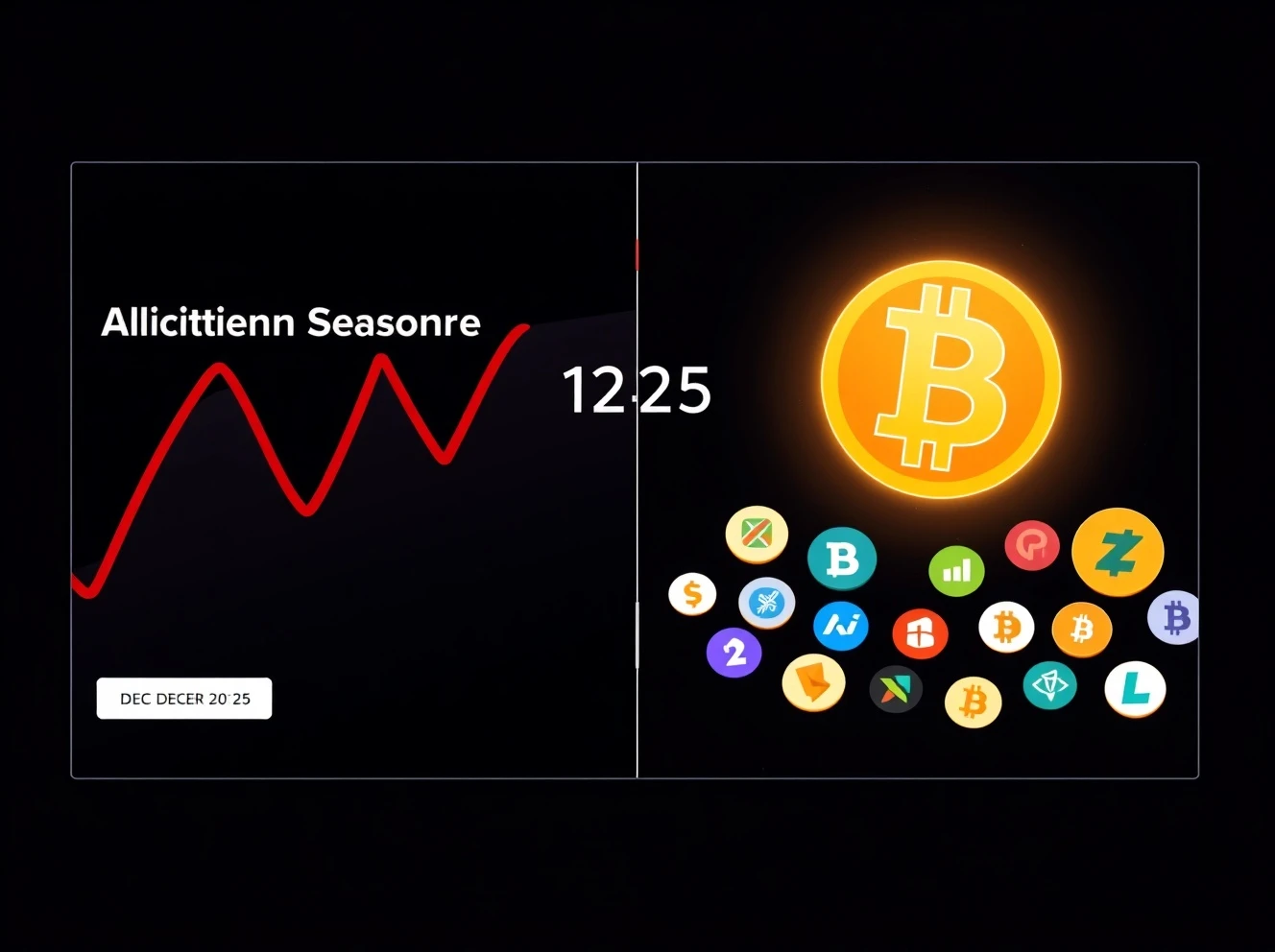
December 25, 2025 – A critical cryptocurrency market indicator has flashed a stark warning signal. The Altcoin Season Index, a widely monitored gauge of market sentiment, has plummeted to a score of 17, according to data from CoinMarketCap. This dramatic drop, far below the 75 threshold that signals an ‘altcoin season,’ underscores a powerful and potentially prolonged phase of Bitcoin dominance. For investors navigating the volatile digital asset landscape, understanding this shift is not just academic—it’s crucial for portfolio management and risk assessment in the coming weeks.
Decoding the Altcoin Season Index Plunge
The Altcoin Season Index functions as a market thermometer, measuring investor risk appetite with precision. Specifically, it calculates the percentage of top 100 cryptocurrencies, excluding stablecoins, that have outperformed Bitcoin over a rolling 90-day window. Consequently, a score above 75 indicates a robust ‘altcoin season,’ where capital rotates aggressively into smaller, riskier assets. Conversely, the current score of 17 paints a clear picture: Bitcoin is decisively outperforming the vast majority of the altcoin market. This metric, therefore, provides a real-time snapshot of capital rotation, offering invaluable context beyond simple price movements.
The Mechanics Behind the Metric
Analysts treat the index as a leading sentiment indicator. It doesn’t just reflect past performance; it signals where smart money may be flowing. When the index falls, it typically precedes or accompanies a rise in Bitcoin’s market dominance metric. This relationship highlights the crypto market’s cyclical nature, where Bitcoin often leads major rallies before capital eventually ‘trickles down’ to altcoins. The current data suggests we are firmly in the former phase.
Analyzing the Drivers of Bitcoin’s Resurgent Dominance
Several interconnected factors are coalescing to drive this market shift. Primarily, a macroeconomic backdrop of uncertainty often triggers a ‘flight to quality’ within crypto. Investors increasingly perceive Bitcoin, with its deep liquidity and established store-of-value narrative, as a relative safe haven compared to more speculative altcoins. Furthermore, sustained institutional inflows into U.S.-listed Bitcoin ETFs continue to funnel capital directly into BTC, creating a powerful demand-side pressure that altcoins currently cannot match.
Additionally, the market’s position within its broader four-year cycle plays a role. Historical patterns frequently show Bitcoin asserting dominance in the early stages of a bull market or during periods of consolidation. The current index level of 17 strongly aligns with this historical precedent, suggesting the market is following a familiar, if challenging, script for altcoin holders.
- Risk-Off Sentiment: Traders are de-risking by moving from volatile altcoins into Bitcoin.
- Institutional Focus: Bitcoin ETF flows create a one-sided demand dynamic.
- Cycle Dynamics: The market is in a phase where Bitcoin strength precedes altcoin rallies.
- Liquidity Preference: In uncertain times, market participants favor the most liquid asset.
Strategic Implications for Crypto Investors
An Altcoin Season Index of 17 is a clear cautionary signal for altcoin bulls, but it is not a universal sell order. Strategic interpretation depends entirely on an investor’s timeframe and goals. For long-term, conviction-driven holders of fundamentally sound altcoin projects, this period may represent a strategic accumulation opportunity, allowing for position building at potentially lower valuations during a market phase that neglects altcoins. However, this approach requires significant patience and rigorous project due diligence.
For short-term traders and tactical allocators, the message is more direct. The momentum unequivocally favors Bitcoin. Chasing short-term pumps in altcoins against this dominant trend carries elevated risk. The index suggests that patience and discipline are paramount, and capital preservation should take precedence over speculative altcoin bets until the trend shows evidence of reversal.
Actionable Portfolio Guidance
Investors can use this data to make informed adjustments. First, conduct a portfolio review to assess your balance between Bitcoin and altcoin exposure. A low Altcoin Season Index might justify a temporary tactical overweight to Bitcoin to align with the prevailing trend. Second, use this quieter phase for deep research. Identify altcoins with strong fundamentals, active development, and resilient communities that are weathering the Bitcoin-dominated storm. These projects are often the first to rally when sentiment shifts.
Finally, implement monitoring protocols. Set alerts for the Altcoin Season Index to climb back above 50, which could serve as an early warning for a sentiment shift. Monitor Bitcoin dominance charts for signs of topping. This proactive approach allows investors to prepare for the next cycle phase rather than react to it.
| Indicator | Current Reading | Implied Market Phase | Typical Investor Action |
|---|---|---|---|
| Altcoin Season Index | 17 | Strong Bitcoin Season | Caution on altcoins; favor BTC |
| Bitcoin Dominance | Likely Rising | Capital Concentration | Seek safety & liquidity |
| Market Sentiment | Risk-Off | Defensive | Reduce speculative exposure |
The Historical Context and Forward Outlook
This is not an unprecedented event. Similar plunges in the Altcoin Season Index have occurred in past cycles, such as during the market consolidation in late 2023 and prior to major Bitcoin-led rallies in 2020. Historically, these phases of extreme Bitcoin dominance have eventually given way to explosive altcoin seasons, but the timing is unpredictable. The catalyst for a reversal often involves a combination of Bitcoin entering a price consolidation phase, a surge in positive altcoin-specific news (like major protocol upgrades or regulatory clarity), and a broader renewal of risk appetite in global financial markets.
The current landscape suggests investors should brace for this Bitcoin-dominated phase to potentially persist through the early part of 2026, especially if macroeconomic headwinds remain. The key for altcoin investors is survival and preparation—ensuring their portfolios can withstand the drought and are positioned for the eventual rainfall.
Conclusion
The dramatic plunge of the Altcoin Season Index to 17 is a significant and data-rich market event. It highlights Bitcoin’s current commanding strength and signals a period of heightened caution for the broader altcoin market. By understanding what this metric measures and the forces driving its decline, investors can transition from reactive to proactive. This involves managing immediate risk, conducting thorough research, and vigilantly monitoring for the early signs of the next capital rotation. In the perpetual cycle between Bitcoin and altcoin seasons, awareness of these crucial shifts is the foundation of informed and strategic cryptocurrency investment.
FAQs
Q1: What does an Altcoin Season Index of 17 mean for my portfolio?
An index of 17 indicates Bitcoin is strongly outperforming altcoins. It suggests reviewing your portfolio’s risk exposure. Tactically, it may be prudent to ensure you are not over-allocated to speculative altcoins in the short term, while long-term holders might see it as a research and accumulation phase.
Q2: How reliable is the Altcoin Season Index as a standalone indicator?
While highly insightful, it should not be used in isolation. It is most powerful when combined with other metrics like Bitcoin dominance, trading volume, and on-chain data. Always consider the broader market context and macroeconomic environment.
Q3: Does a low index mean all altcoins are performing poorly?
Not necessarily. The index measures the *majority* of top altcoins. Some individual projects with very strong specific catalysts may still outperform Bitcoin even during this phase. However, such outliers are the exception, not the rule, when the index is this low.
Q4: What specific event could cause the Altcoin Season Index to rise rapidly?
A rapid rise could be triggered by a combination of Bitcoin price stabilization or correction, coupled with a major positive catalyst for the altcoin sector, such as favorable regulatory news for Ethereum or a surge in decentralized finance (DeFi) activity.
Q5: Where can I find complementary data to the Altcoin Season Index?
For a fuller picture, analysts recommend also monitoring the Bitcoin Dominance chart on TradingView or CoinMarketCap, funding rates on major exchanges for sentiment, and development activity on platforms like GitHub for fundamental altcoin health.