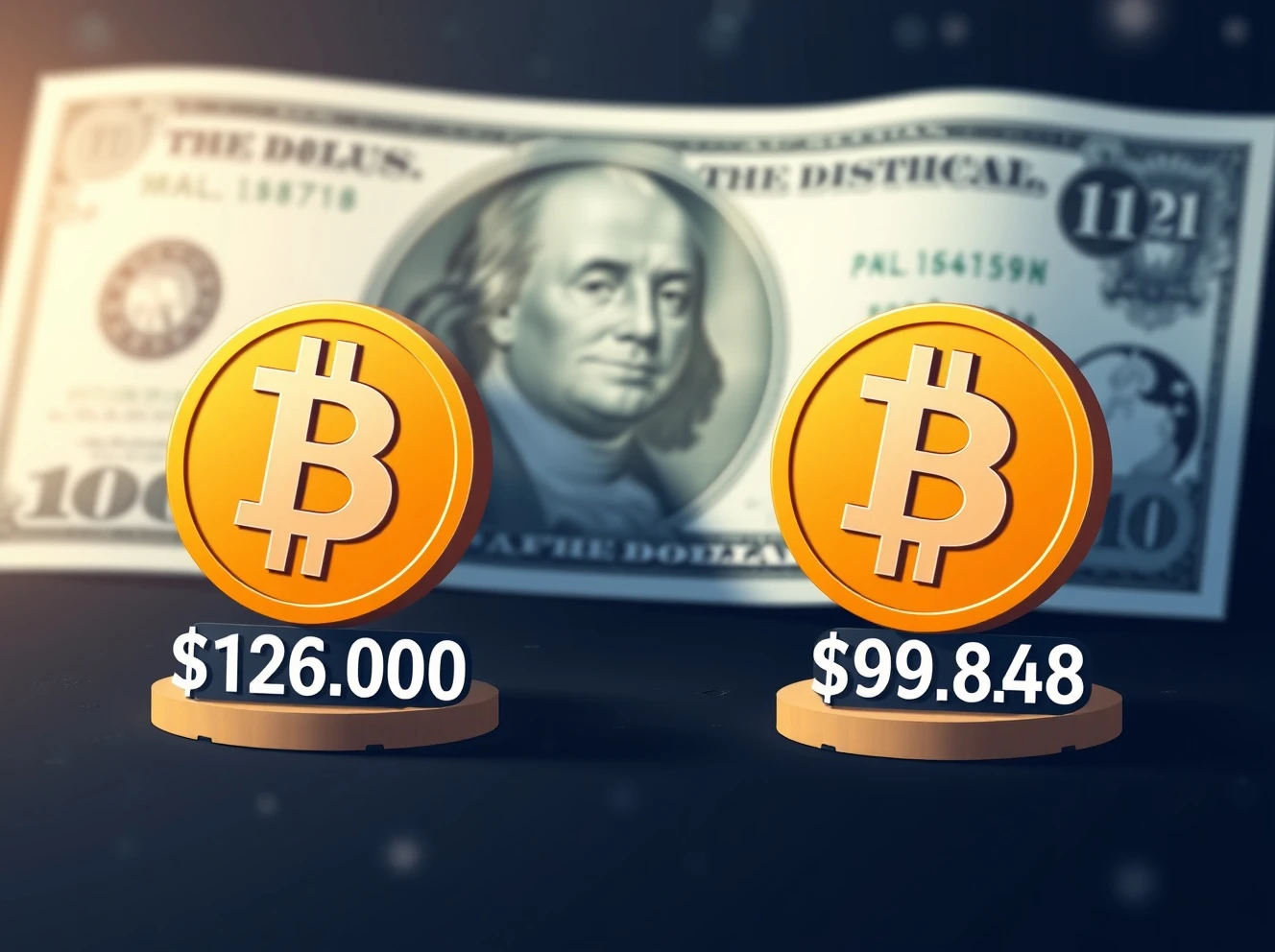
In October 2025, cryptocurrency markets celebrated Bitcoin’s apparent breakthrough past the $126,000 threshold, yet a deeper economic analysis reveals this milestone masks a crucial reality: when adjusted for inflation, Bitcoin has never truly exceeded $100,000 in real purchasing power. This discrepancy between nominal records and actual value highlights fundamental shifts in how we measure financial success in an era of monetary erosion.
Bitcoin’s Inflation-Adjusted Valuation Reality
Galaxy Digital analyst Alex Thorn’s recent analysis provides critical context for Bitcoin’s 2025 market performance. Using the Consumer Price Index (CPI) as his benchmark, Thorn calculated that Bitcoin’s October 2025 peak of $126,000 actually represents just $99,848 in constant 2020 dollars. This 20% adjustment reflects the dollar’s substantial loss of purchasing power over the five-year period from 2020 to 2025.
The cumulative inflation rate during this timeframe reached approximately 24%, according to Federal Reserve data and Bureau of Labor Statistics reports. Consequently, media celebrations of Bitcoin’s nominal records often overlook this essential economic context. Financial markets typically report raw numbers without inflation adjustments, creating what economists call “money illusion”—the tendency to think in nominal rather than real terms.
The Mechanics of Monetary Erosion
Understanding Bitcoin’s real value requires examining the tools economists use to measure purchasing power. The Consumer Price Index tracks changes in the price level of a market basket of consumer goods and services. Between 2020 and 2025, this basket’s cost increased significantly, meaning each dollar today buys substantially less than it did five years earlier.
This erosion affects all dollar-denominated assets, not just cryptocurrencies. However, Bitcoin’s volatility and media attention make its nominal records particularly susceptible to misinterpretation. The table below illustrates the inflation adjustment process:
| Year | Nominal BTC Price | 2020 Dollar Value | Inflation Adjustment |
|---|---|---|---|
| 2020 | $29,000 | $29,000 | 0% |
| 2023 | $68,000 | $56,800 | -16.5% |
| 2025 | $126,000 | $99,848 | -20.7% |
Cryptocurrency’s Philosophical Dilemma
The application of traditional macroeconomic tools to Bitcoin valuation raises fundamental questions about cryptocurrency’s original purpose. Bitcoin emerged as a response to traditional financial systems, with creator Satoshi Nakamoto explicitly criticizing central banking and fiat currency devaluation in the original whitepaper. Using inflation-adjusted metrics to evaluate Bitcoin’s success represents what some purists consider institutional co-optation.
Prominent cryptocurrency commentator BitKane articulated this concern on social media platform X: “If we start looking at bitcoin’s price from the angle of ‘adjustment,’ aren’t we simply recreating the same system?” This tension highlights the broader cryptocurrency community’s ongoing debate between ideological purity and mainstream adoption.
Several key developments illustrate this institutional integration trend:
- Ethereum’s evolution toward enterprise-friendly rollups and layer-2 solutions
- Stablecoin proliferation backed by traditional fiat currencies
- Regulatory frameworks developing in major financial jurisdictions
- Institutional investment products like Bitcoin ETFs gaining mainstream acceptance
Expert Perspectives on Valuation Methodology
Financial analysts remain divided on appropriate cryptocurrency valuation methods. Traditional economists argue that inflation adjustment provides essential context for comparing asset performance across different time periods. Meanwhile, cryptocurrency native analysts often emphasize Bitcoin’s properties as a potential inflation hedge rather than a dollar-denominated asset.
Alex Thorn’s analysis represents the traditional economic perspective, applying standard macroeconomic tools to cryptocurrency valuation. His approach assumes that comparing Bitcoin’s performance against inflation-adjusted dollars provides more meaningful information than nominal prices alone. This methodology aligns with how institutional investors evaluate traditional assets like stocks, bonds, and commodities.
Conversely, cryptocurrency maximalists frequently argue that Bitcoin should be evaluated against its own metrics, particularly its fixed supply and decentralized nature. They contend that comparing Bitcoin to deteriorating fiat currencies misses its fundamental value proposition as an alternative monetary system.
Market Implications and Future Projections
The inflation adjustment debate has practical implications for investor decision-making and market psychology. Nominal price targets often drive retail investor enthusiasm and media coverage, while institutional investors typically consider real returns after accounting for inflation and other economic factors.
Galaxy Digital maintains a bullish long-term outlook despite these valuation complexities. The firm projects Bitcoin could reach $250,000 by late 2027, driven by increasing institutional adoption and broader macroeconomic trends. This projection accounts for both potential Bitcoin appreciation and continued fiat currency devaluation.
Market data reveals several important trends in Bitcoin’s evolving role:
- Volatility patterns increasingly resemble those of established commodities
- Options market development indicates growing financial sophistication
- Correlation patterns with traditional assets show changing relationships
- Trading volume distribution reflects increasing institutional participation
The Broader Economic Context
Bitcoin’s inflation adjustment debate occurs against a backdrop of significant global economic shifts. Central banks worldwide have implemented unprecedented monetary policies since 2020, including quantitative easing programs and near-zero interest rates. These policies have accelerated currency devaluation concerns among investors seeking inflation-resistant assets.
The dollar’s purchasing power decline represents part of a broader trend affecting multiple fiat currencies. International investors increasingly consider Bitcoin alongside traditional inflation hedges like gold, real estate, and Treasury Inflation-Protected Securities (TIPS). This comparative analysis will likely intensify as global debt levels continue rising and monetary policies remain accommodative.
Several economic indicators suggest persistent inflationary pressures:
- Global debt-to-GDP ratios remain at historically elevated levels
- Supply chain restructuring continues affecting production costs
- Demographic shifts in major economies influence labor markets
- Energy transition investments create new inflationary dynamics
Conclusion
Bitcoin’s 2025 market performance illustrates the complex relationship between nominal records and real economic value. While the cryptocurrency’s $126,000 peak captured headlines and investor imagination, its inflation-adjusted value of approximately $99,848 provides crucial context for understanding true purchasing power. This analysis reveals how traditional economic tools increasingly influence cryptocurrency valuation, reflecting Bitcoin’s ongoing integration into mainstream financial systems. As cryptocurrency markets mature, investors must consider both nominal prices and real inflation-adjusted returns when evaluating Bitcoin’s performance and long-term potential as an alternative asset class.
FAQs
Q1: What does “inflation-adjusted Bitcoin price” mean?
Inflation adjustment converts nominal Bitcoin prices into constant dollars from a specific base year, accounting for changes in purchasing power. This allows meaningful comparison of Bitcoin’s value across different time periods despite currency devaluation.
Q2: How do analysts calculate Bitcoin’s real value?
Analysts typically use the Consumer Price Index (CPI) to adjust Bitcoin’s nominal price. They divide the current price by the cumulative inflation rate since their chosen base year, revealing the cryptocurrency’s purchasing power in constant dollars.
Q3: Why does inflation adjustment matter for cryptocurrency investors?
Inflation adjustment helps investors understand whether Bitcoin’s price increases represent real gains or simply keep pace with currency devaluation. This distinction affects investment strategy, risk assessment, and performance evaluation against traditional assets.
Q4: Does inflation adjustment contradict Bitcoin’s original purpose?
Some cryptocurrency purists argue that evaluating Bitcoin using traditional economic tools contradicts its original purpose as an alternative to fiat systems. However, mainstream analysts consider inflation adjustment essential for comparing Bitcoin with other investment options.
Q5: How does Bitcoin’s inflation-adjusted performance compare to traditional assets?
Despite never exceeding $100,000 in real 2020 dollars, Bitcoin has significantly outperformed most traditional assets since its inception when measured by inflation-adjusted returns, though with substantially higher volatility and risk.