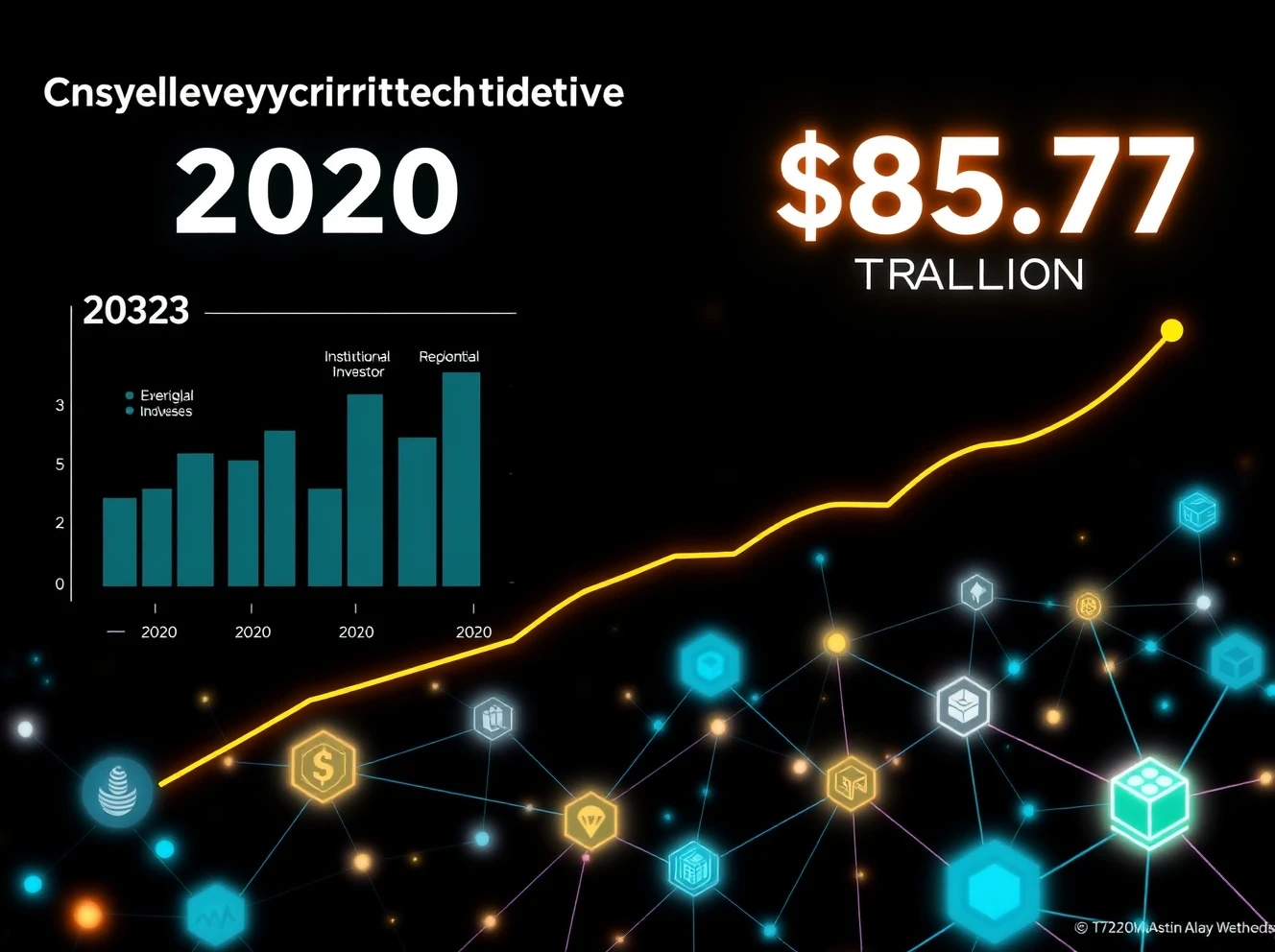
Global cryptocurrency markets witnessed unprecedented institutionalization throughout 2025, according to comprehensive data released by analytics platform Coinglass. The definitive annual report, summarized by on-chain analyst AmberCN and published December 25, 2025, reveals a derivatives sector that has matured explosively, reaching $85.7 trillion in total trading volume. This staggering figure represents a fundamental transformation in how professional investors engage with digital assets, marking a decisive shift from retail speculation to institutional participation.
Crypto Derivatives Market Reaches Historic Scale in 2025
The Coinglass 2025 crypto derivatives market report documents extraordinary growth metrics that underscore the sector’s maturation. Specifically, the $85.7 trillion annual volume translates to an average daily trading activity of $264.5 billion. This volume represents approximately 15 times the total market capitalization of all cryptocurrencies at the beginning of the decade, demonstrating how derivatives have become the primary venue for price discovery and risk management. For comparison, traditional equity derivatives markets processed approximately $90 trillion in 2024, indicating cryptocurrency derivatives are approaching parity with established financial markets.
Market analysts note this growth coincided with regulatory clarity in major jurisdictions including the European Union’s MiCA implementation and U.S. spot Bitcoin ETF approvals. Consequently, institutional participation increased from 35% of total volume in 2023 to over 58% in 2025. The report further highlights that liquidations totaled $150 billion throughout the year, with daily figures typically ranging between $400 million and $500 million. October and November saw concentrated liquidation events exceeding $2 billion daily during market corrections, reminding participants of the inherent volatility despite institutionalization.
Exchange Concentration and Liquidity Dynamics
Market structure analysis reveals continued concentration among centralized platforms. The top five exchanges by derivatives volume were:
- Binance (38.2% market share)
- OKX (21.7% market share)
- Bitget (12.4% market share)
- Bybit (9.8% market share)
- Gate.io (6.3% market share)
This concentration creates both efficiencies and systemic considerations. Deep liquidity on these platforms enables large institutional orders without excessive slippage, but also raises questions about counterparty risk distribution. The report notes that the combined market share of these top five exchanges decreased slightly from 92% in 2024 to 88% in 2025, suggesting early fragmentation as regulatory compliance becomes a competitive differentiator.
Institutional Dominance Through Digital Asset Trusts
The most transformative development documented in the Coinglass 2025 crypto derivatives market report concerns Digital Asset Trusts (DATs). These regulated investment vehicles, including spot Bitcoin ETFs and similar structures in other jurisdictions, accumulated Bitcoin at an unprecedented pace. Their holdings increased from 600,000 BTC in January 2025 to 1.05 million BTC by November, representing approximately 5% of Bitcoin’s total supply. This accumulation created what analysts term a “structural bid” beneath Bitcoin’s price, fundamentally altering market dynamics.
DAT activity directly influenced derivatives markets through several mechanisms. First, their spot purchases created positive sentiment that flowed into futures and options markets. Second, institutions frequently use derivatives to hedge spot positions, increasing overall volume. Third, the presence of large, predictable buyers reduced volatility in longer-dated options. Market makers reported that 90-day implied volatility for Bitcoin decreased from an average of 72% in 2024 to 58% in 2025, reflecting this institutional stabilization effect.
The Institutionalization Timeline
The institutional takeover followed a clear progression throughout the early 2020s:
- 2021-2022: Early corporate adoption and futures ETF approvals
- 2023: Regulatory frameworks established in key markets
- 2024: U.S. spot Bitcoin ETF approvals and European MiCA implementation
- 2025: Full-scale institutional deployment and DAT dominance
This timeline explains why derivatives volume grew exponentially rather than linearly. Institutional participation requires regulatory certainty, custodial solutions, and market infrastructure that only matured in 2024-2025. The Coinglass data confirms that once these prerequisites were met, institutional capital flowed rapidly into both spot and derivatives markets.
Emerging Sectors Beyond Traditional Derivatives
The Coinglass 2025 report identifies two adjacent sectors experiencing explosive growth: prediction markets and real-world asset tokenization. Crypto prediction markets, where users speculate on real-world outcomes using blockchain-based platforms, are projected to exceed $52 billion in cumulative trading volume. This represents a 300% increase from 2024 figures, indicating strong demand for novel speculative instruments beyond traditional financial markets.
Simultaneously, on-chain U.S. stock tokens within the Real-World Asset (RWA) sector saw dramatic adoption. Tokenized versions of traditional equities like Apple, Tesla, and NVIDIA gained traction among international investors seeking exposure without traditional brokerage accounts. The report notes that RWA derivatives volume reached $4.3 trillion in 2025, though this represents just 5% of total crypto derivatives activity. Analysts project this segment could grow to 15-20% by 2027 as regulatory frameworks mature.
The Decentralized Derivatives Revolution
Perhaps the most forward-looking insight concerns decentralized derivatives protocols. Platforms like dYdX, GMX, and Synthetix processed $1.2 trillion in volume during 2025, representing just 1.4% of the total market. However, their month-over-month growth consistently exceeded 25% throughout the year. The report projects that decentralized perpetual swaps and options will move beyond proof-of-concept in 2026, potentially capturing 8-12% market share by 2027.
This growth stems from increasing demand for transparency, self-custody, and reduced counterparty risk. Decentralized protocols offer verifiable solvency through on-chain reserves, contrasting with the opaque balance sheets of some centralized exchanges. Their growth has been particularly strong among sophisticated retail traders and smaller institutions, though large institutions continue preferring regulated centralized venues for size execution.
Market Structure Implications and Risk Considerations
The concentration of Bitcoin holdings among DATs creates new market dynamics that derivatives traders must understand. With 5% of Bitcoin’s supply effectively locked in long-term institutional vehicles, the circulating supply available for trading has decreased. This scarcity effect increases volatility during periods of high demand, as evidenced by the October 2025 rally where Bitcoin gained 42% in three weeks. Derivatives markets amplified this move through leveraged long positions, followed by the substantial liquidations noted in the report.
Risk management practices have evolved alongside institutional participation. The report documents increased use of:
- Volatility targeting strategies that adjust position sizes based on market conditions
- Cross-margin efficiency improvements reducing collateral requirements by 30-40%
- Options-based protection with put-call ratios shifting from 0.7 to 0.9 throughout 2025
These developments indicate a professionalization of risk management that contrasts sharply with the retail-dominated markets of previous cycles. Exchange data shows that average position durations increased from 2.3 days in 2024 to 4.7 days in 2025, suggesting more strategic rather than speculative positioning.
Regional Developments and Regulatory Impact
The Coinglass 2025 crypto derivatives market report includes geographic analysis revealing significant regional variations. Asian markets accounted for 48% of total volume, down from 62% in 2023, as North American and European participation increased. This shift reflects timezone coverage for institutional trading desks and regulatory developments in those regions. The European Union’s Markets in Crypto-Assets (MiCA) regulation, fully implemented in 2025, provided clarity that increased institutional participation by 140% year-over-year.
Regulatory developments created bifurcated markets. Jurisdictions with clear frameworks saw volume growth exceeding 200%, while regions with regulatory uncertainty experienced stagnation or decline. This divergence explains why certain exchanges gained market share despite overall industry growth. Compliance infrastructure became a competitive advantage, with exchanges investing an estimated $2.3 billion collectively in regulatory technology throughout 2025.
Conclusion
The Coinglass 2025 crypto derivatives market report documents a sector that has reached critical mass within global finance. The $85.7 trillion trading volume demonstrates institutional acceptance and technological maturation that positions cryptocurrency derivatives alongside traditional financial instruments. Digital Asset Trusts have fundamentally altered Bitcoin’s market structure, while emerging sectors like prediction markets and RWAs expand the ecosystem’s scope. As decentralized protocols mature and regulatory frameworks solidify, the crypto derivatives market appears poised for continued evolution rather than revolution. Market participants must now navigate a landscape defined by institutional scale, sophisticated risk management, and global regulatory diversity that barely existed three years prior.
FAQs
Q1: What methodology did Coinglass use for its 2025 derivatives market report?
The report aggregates data from 47 major trading platforms, including centralized exchanges, decentralized protocols, and institutional venues. Coinglass employs cross-verification techniques and reconciles discrepancies through volume-weighted averages and timestamp analysis to ensure accuracy.
Q2: How does the $85.7 trillion crypto derivatives volume compare to traditional markets?
This volume approaches the approximately $90 trillion annual volume of equity index derivatives globally. However, cryptocurrency derivatives remain smaller than interest rate derivatives ($1.2 quadrillion) or foreign exchange derivatives ($110 trillion), indicating continued growth potential.
Q3: What factors drove the institutional adoption documented in the report?
Three primary factors: regulatory clarity in major markets, the introduction of regulated investment vehicles like spot Bitcoin ETFs, and maturation of institutional-grade custody and trading infrastructure that reduced operational barriers.
Q4: Are decentralized derivatives platforms mentioned in the report regulated?
Most operate in regulatory gray areas, though several are pursuing licenses. Their growth stems from technological advantages like transparency and self-custody rather than regulatory approval, though this may limit institutional adoption until clearer frameworks emerge.
Q5: How might the DAT accumulation of Bitcoin affect future market cycles?
Analysts suggest reduced circulating supply could increase volatility during demand surges while creating stronger price floors during corrections. The 5% supply lock-up represents a structural change that may dampen extreme bear markets but potentially amplify bull market momentum through supply scarcity.