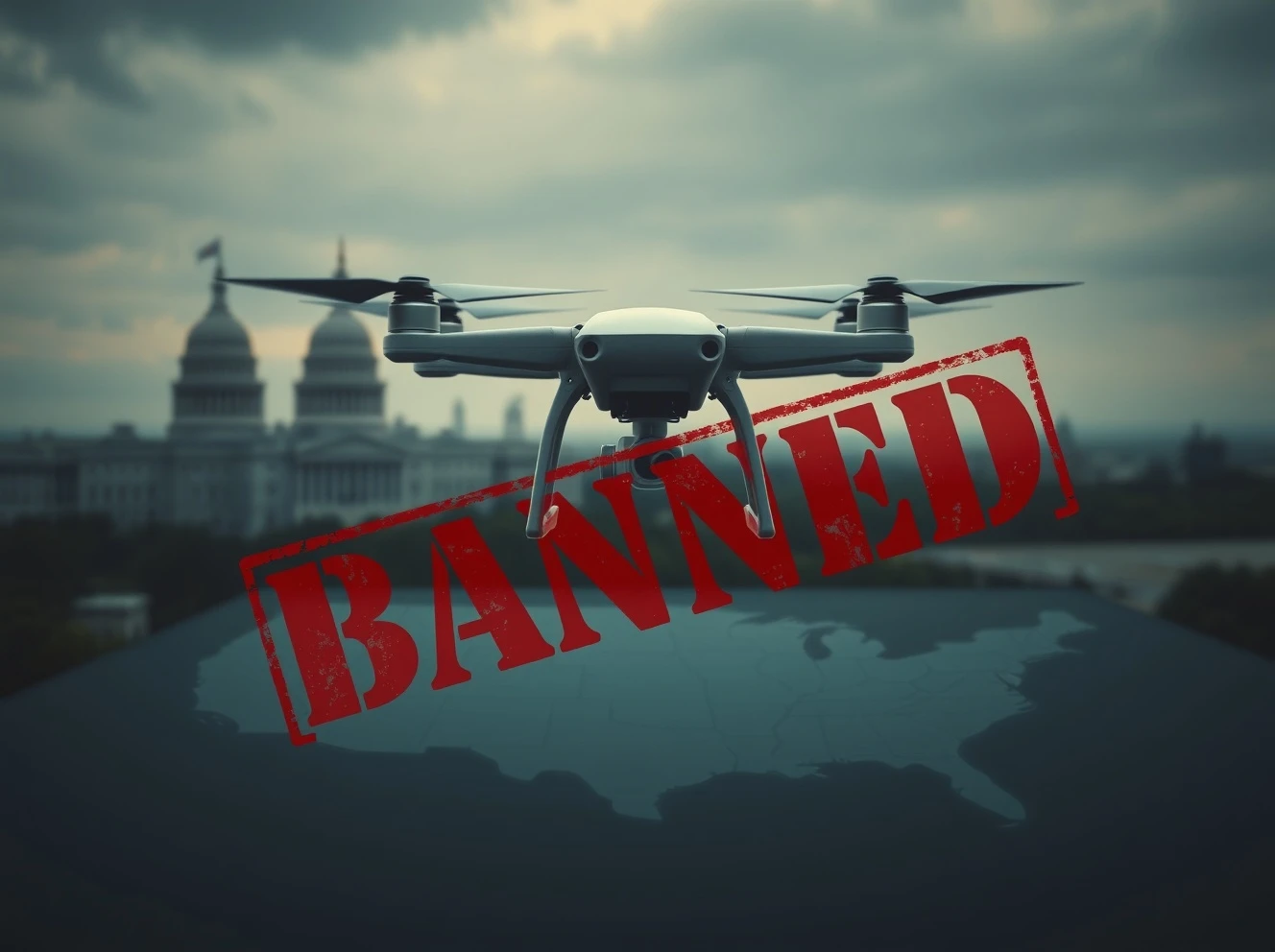
WASHINGTON, D.C. — December 2024 — The United States drone market faces immediate disruption this week as the Federal Communications Commission enforces a sweeping ban on all new foreign-made unmanned aerial systems, delivering a devastating blow to industry leader DJI and fundamentally reshaping American airspace security policy. This unprecedented regulatory action, stemming from a Trump administration executive order, prohibits the distribution of new foreign drone models while allowing existing owners to continue operating older devices, creating a complex landscape for commercial operators, hobbyists, and national security agencies alike.
FCC Drone Ban: The National Security Rationale
The Federal Communications Commission published its final determination on Monday, adding all “UAS and UAS critical components produced abroad” to its Covered List of products posing unacceptable national security risks. Consequently, the agency cited specific concerns about potential exploitation by “criminals, hostile foreign actors, and terrorists” who could weaponize drone technology against American infrastructure. Furthermore, FCC Chairman Brendan Carr explicitly endorsed the policy, stating it would “unleash American drone dominance” following President Trump’s leadership. This regulatory move represents the culmination of years of escalating scrutiny toward Chinese technology companies operating within U.S. critical infrastructure sectors.
Historically, the U.S. government has expressed mounting anxiety about data security vulnerabilities in foreign-made drones. Multiple defense and homeland security assessments have highlighted potential backdoor access points in drone firmware and data transmission systems. Additionally, the Department of Homeland Security issued warnings as early as 2017 about possible data harvesting by foreign manufacturers. The current FCC action therefore formalizes these concerns into enforceable policy, creating immediate market consequences.
The Executive Order Foundation
This week’s enforcement stems directly from a June 2024 executive order that explicitly sought to “secure the United States drone supply chain against foreign control or exploitation.” The order established a comprehensive framework for boosting domestic drone manufacturing while systematically phasing out foreign-sourced components from critical applications. Moreover, it mandated interagency collaboration between the FCC, Department of Defense, and Department of Commerce to identify specific technological vulnerabilities. This coordinated approach reflects the administration’s broader technology decoupling strategy, which has previously targeted telecommunications equipment and social media platforms.
DJI’s Market Dominance and Immediate Response
Chinese manufacturer DJI currently controls approximately 70-80% of the global consumer and commercial drone market, with particularly strong penetration in the United States across multiple sectors. The company’s products have become ubiquitous tools for photographers, surveyors, agricultural managers, and first responders. Following the FCC announcement, DJI issued a formal statement expressing disappointment while emphasizing its safety record. “DJI products are among the safest and most secure on the market,” the company asserted, referencing “years of reviews conducted by U.S. government agencies and independent third parties.”
The manufacturer’s response highlighted several key points:
- Transparency Concerns: DJI noted “no information has been released regarding what information was used by the Executive Branch in reaching its determination”
- Market Advocacy: The company reaffirmed its commitment to “an open, competitive market that benefits all US consumers and commercial users”
- Operational Continuity: DJI emphasized continued support for existing products already in American hands
Industry analysts immediately projected significant market disruption. Commercial operators who standardized on DJI platforms for their reliability, camera systems, and software ecosystems now face uncertain upgrade paths. Meanwhile, American drone manufacturers like Skydio, Parrot, and emerging startups stand to gain substantial market share, though they currently lack DJI’s production scale and price competitiveness.
Comparative Impact: Foreign vs. Domestic Drone Markets
| Market Segment | Pre-Ban Foreign Share | Post-Ban Projection | Primary Domestic Alternatives |
|---|---|---|---|
| Consumer Hobbyist | ~85% | ~40% | Autel, Skydio (premium) |
| Commercial Photography | ~90% | ~30% | Skydio, Parrot Anafi |
| Industrial Inspection | ~75% | ~25% | American Robotics, Inspired Flight |
| Public Safety | ~70% | ~15% | BRINC, Teal Drones |
This transition will inevitably create supply chain challenges and price increases for American consumers. Domestic manufacturers currently lack the vertical integration that enabled DJI’s cost structure, particularly in battery technology and camera sensors. However, the Department of Defense’s “Blue UAS” program has already certified several American-made drones for government use, providing a foundation for scaled production. These certified platforms typically cost 2-3 times more than comparable DJI models, presenting adoption barriers for budget-conscious commercial operators.
Technical Security Concerns and Verification Challenges
The FCC’s determination references specific technical vulnerabilities that allegedly justify the blanket prohibition. According to cybersecurity experts familiar with drone systems, primary concerns include:
- Data Transmission Encryption: Potential weaknesses in how drones encrypt video feeds and telemetry data
- Firmware Updates: Unverified code that could introduce surveillance capabilities during routine updates
- Geofencing Systems: Possible manipulation of no-fly zone enforcement around sensitive facilities
- Component Sourcing: Use of Chinese-made chips with documented security vulnerabilities
Notably, the FCC has not released detailed technical evidence supporting these specific claims against DJI or other manufacturers. This lack of public documentation contrasts with previous technology restrictions, such as those against Huawei, where the government provided extensive technical briefings to allies. Consequently, some industry observers question whether the ban represents genuine security necessity or broader geopolitical positioning within U.S.-China technology competition.
Existing User Implications and Grandfathering Provisions
The FCC’s policy includes explicit grandfathering provisions for drones already purchased and operational within the United States. These existing devices will continue to receive necessary software updates and technical support from manufacturers, according to agency guidance. However, several important limitations apply:
- No new foreign-made drones can enter U.S. distribution channels after the effective date
- Commercial operators cannot expand their fleets with additional foreign models
- Repair parts must be sourced from existing U.S. inventory or domestic alternatives
- Future firmware updates remain subject to potential additional restrictions
This creates a peculiar market dynamic where used DJI drones may appreciate in value due to scarcity, while new domestic alternatives struggle to match capability parity. Additionally, public safety agencies that standardized on DJI platforms for search-and-rescue operations now face difficult migration decisions with substantial budget implications.
Broader Geopolitical Context and Technology Decoupling
The drone ban represents the latest escalation in ongoing technology sector tensions between the United States and China. Previously, the Trump administration targeted TikTok, WeChat, Huawei, and semiconductor technology transfers through similar national security frameworks. This pattern reflects a deliberate strategy of technological decoupling—systematically reducing American dependence on Chinese-made critical infrastructure components. Observers note that drones occupy a particularly sensitive position within this framework due to their dual-use capabilities for both commercial applications and potential military adaptation.
International reactions have been mixed. European allies have expressed concern about the precedent while conducting their own security reviews of Chinese drone technology. Meanwhile, Chinese officials have denounced the move as “economic coercion” and “unfair trade practices,” suggesting potential retaliatory measures against American technology companies operating in China. This escalating tit-for-tat dynamic threatens to further fragment global technology standards and supply chains, potentially creating separate Western and Chinese technological ecosystems.
Domestic Industry Response and Manufacturing Challenges
American drone manufacturers have welcomed the policy shift while acknowledging significant production challenges. Skydio, currently the best-positioned domestic alternative, has announced plans to expand manufacturing capacity but notes supply chain constraints for specialized components. “Building a complete vertical supply chain takes years, not months,” acknowledged a company spokesperson. Smaller manufacturers face even greater hurdles, particularly in sourcing affordable high-resolution cameras and flight controllers previously dominated by Chinese suppliers.
The Department of Commerce has announced grant programs to accelerate domestic drone manufacturing, focusing on:
- Semiconductor partnerships for specialized drone processors
- Battery research initiatives to match Chinese lithium polymer technology
- Camera sensor development through academic-industry collaborations
- Software ecosystem funding to rival DJI’s mature flight control applications
These initiatives will require substantial time and investment before yielding competitive products. In the interim, many commercial operators may simply extend the lifespan of their existing DJI fleets through careful maintenance and component stockpiling.
Legal Challenges and Potential Court Actions
Legal experts anticipate multiple challenges to the FCC’s authority to implement such a broad import ban. Previous technology restrictions have faced judicial scrutiny regarding procedural compliance and evidentiary standards. Potential legal arguments include:
- Whether the FCC exceeded its statutory authority under the Communications Act
- Whether the agency provided sufficient due process to affected companies
- Whether the blanket prohibition constitutes arbitrary and capricious rulemaking
- Whether the policy violates international trade agreements
DJI has not announced specific litigation plans but retains significant legal resources from previous regulatory battles. Meanwhile, industry associations representing commercial drone users may file separate challenges focusing on economic impact rather than national security justification. These legal proceedings could delay full implementation for months or years, creating regulatory uncertainty for all market participants.
Conclusion
The FCC drone ban represents a watershed moment for American aviation technology policy, with immediate consequences for consumers, commercial operators, and national security planning. This decisive action against foreign-made drones, particularly market leader DJI, reflects escalating concerns about technological dependence and infrastructure vulnerability. While the policy aims to stimulate domestic drone manufacturing and enhance security, it creates substantial transition challenges and potential market disruption. The coming months will reveal whether American manufacturers can rapidly scale production to meet demand, whether legal challenges delay implementation, and whether the security benefits justify the economic costs. Ultimately, this FCC drone ban may fundamentally reshape not only what flies in American airspace, but who controls the technology guiding its flight.
FAQs
Q1: Can I still fly my existing DJI drone after the ban?
A1: Yes, the FCC explicitly grandfathers existing drones. You can continue operating currently owned foreign-made drones, and manufacturers will provide software updates and support for these devices.
Q2: Will DJI drones become illegal to own in the United States?
A2: No, ownership remains legal. The ban affects only new distributions and sales, not existing possession. However, you cannot purchase new DJI models after the effective date.
Q3: What American-made drones are available as alternatives?
A3: Several domestic manufacturers offer alternatives, including Skydio for autonomous drones, Parrot for commercial models, and Teal Drones for public safety applications. Prices are typically higher than comparable DJI products.
Q4: How will this affect commercial drone operators who use DJI equipment?
A4: Commercial operators face significant challenges. They cannot expand fleets with new DJI drones and must eventually transition to more expensive domestic alternatives. Many will extend existing equipment lifespan through maintenance and repairs.
Q5: Does this ban affect drone parts and accessories?
A5: Yes, the prohibition includes “UAS critical components produced abroad.” This covers batteries, cameras, flight controllers, and other essential parts. Repair parts must come from existing U.S. inventory or domestic sources.