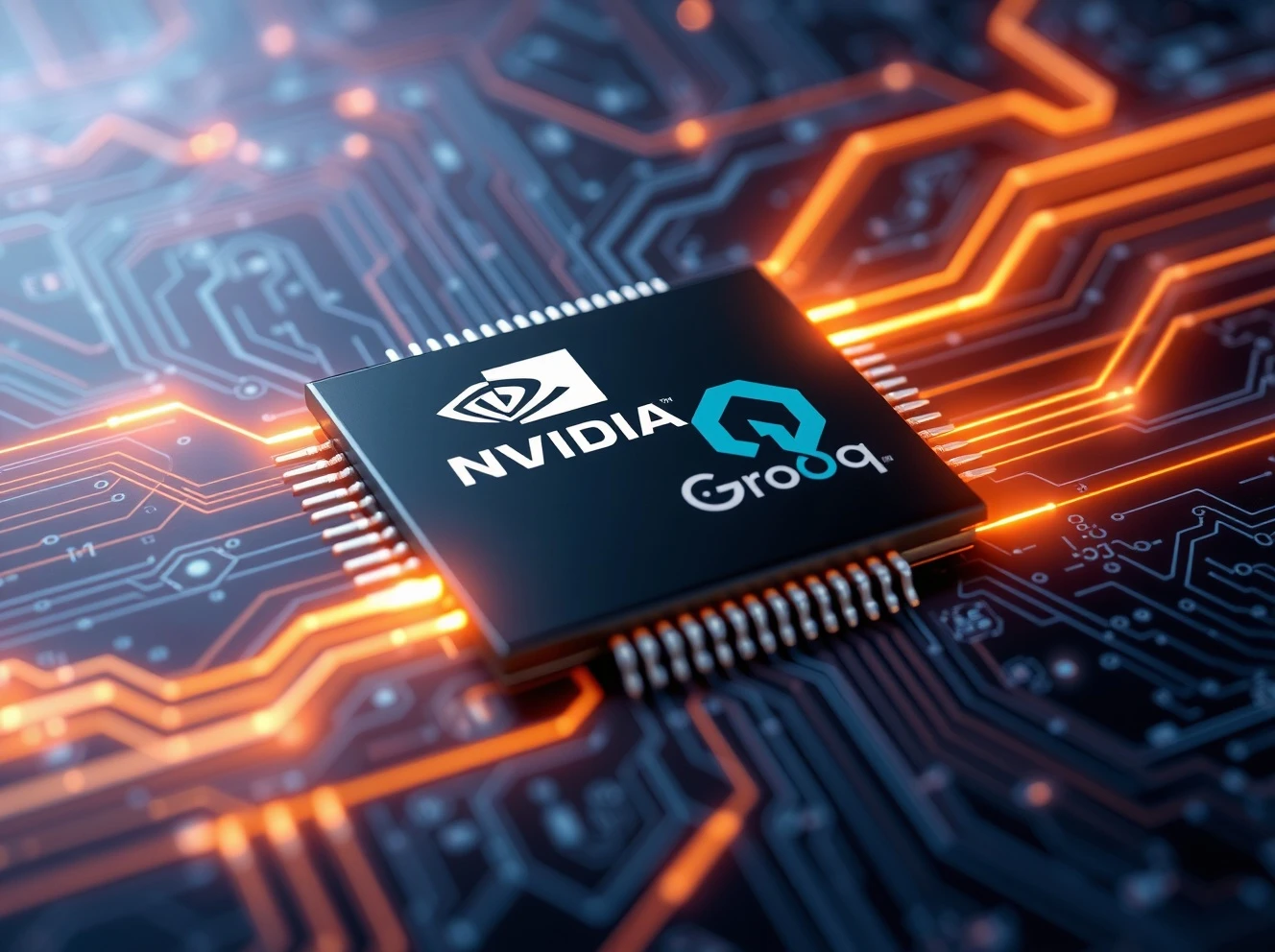
In a landmark transaction that fundamentally alters the semiconductor landscape, Nvidia Corporation has executed its largest acquisition ever—purchasing artificial intelligence chip innovator Groq for a staggering $20 billion. This strategic move, announced on December 25, 2025, represents more than a corporate transaction; it signals a pivotal shift in how computational power will be structured for the next generation of AI applications. The acquisition immediately consolidates Nvidia’s position as the dominant force in AI hardware while neutralizing one of its most promising competitors.
Nvidia’s Groq Acquisition Reshapes Competitive Dynamics
The semiconductor industry has witnessed escalating competition as companies race to develop specialized AI hardware. Nvidia’s acquisition of Groq represents a calculated strategic pivot rather than a defensive reaction. Industry analysts note that Groq had demonstrated remarkable growth, serving over 2 million developers compared to just 356,000 the previous year. The company’s September funding round valued Groq at $6.9 billion after raising $750 million, indicating rapid market traction that could have threatened Nvidia’s dominance in specific AI segments.
This transaction follows a pattern of strategic consolidation within the semiconductor sector. However, the $20 billion valuation represents a premium that underscores Groq’s technological value. Market observers point to several immediate impacts: Nvidia eliminates a direct competitor in the specialized AI inference market, gains access to complementary technology, and acquires significant engineering talent. The deal also positions Nvidia to offer a more comprehensive hardware portfolio spanning both general-purpose and specialized AI computation.
The LPU Technology Advantage
Groq’s primary technological innovation centers on its Language Processing Unit architecture. Unlike Nvidia’s Graphics Processing Units, which excel at parallel processing for diverse applications including AI training and graphics rendering, LPUs are specifically optimized for running large language models. Groq’s technical documentation claims these specialized chips can operate LLMs at ten times the speed while consuming only one-tenth the energy of traditional GPU solutions.
| Technology | Primary Application | Key Advantage | Energy Efficiency |
|---|---|---|---|
| Nvidia GPU | General AI/Graphics | Parallel Processing | Industry Standard |
| Groq LPU | Language Models | Specialized Speed | 10x Better |
| Google TPU | Tensor Operations | Custom AI Acceleration | Cloud-Optimized |
The LPU’s architectural approach differs fundamentally from traditional designs. Groq’s technology employs a deterministic execution model that eliminates scheduling overhead, enabling predictable latency—a critical factor for real-time AI applications. This specialization makes LPUs particularly valuable for inference workloads where large language models must generate responses rapidly and efficiently.
Strategic Implications for the Semiconductor Industry
Nvidia’s acquisition signals a broader industry trend toward vertical integration and specialization. As AI applications diversify across sectors—from healthcare diagnostics to autonomous systems—hardware requirements become increasingly specific. The traditional one-architecture-fits-all approach faces limitations when optimizing for particular workloads. Consequently, companies controlling multiple specialized architectures gain competitive advantages in performance and efficiency.
The transaction’s immediate consequences include:
- Market Consolidation: Nvidia strengthens its leadership position across both general and specialized AI hardware segments
- Technology Integration: Potential combinations of GPU and LPU technologies could create hybrid solutions
- Developer Ecosystem Expansion: Groq’s 2 million developers gain access to Nvidia’s comprehensive toolchain
- Competitive Response Acceleration: Rivals including AMD, Intel, and Google may accelerate alternative development
Historical context reveals this acquisition follows Nvidia’s established pattern of strategic technology acquisition. The company previously acquired Mellanox Technologies for $6.9 billion in 2019 to strengthen its data center networking capabilities and Arm Limited for $40 billion in 2020 (though that transaction faced regulatory challenges). Each acquisition has systematically expanded Nvidia’s technological portfolio and market reach.
Integration Challenges and Regulatory Considerations
Despite the strategic rationale, significant integration challenges await Nvidia. Merging distinct corporate cultures, technology stacks, and development philosophies requires careful management. Groq’s engineering team, including CEO Jonathan Ross—who previously contributed to Google’s Tensor Processing Unit development—brings specialized expertise but may face cultural integration hurdles within Nvidia’s established structure.
Regulatory scrutiny presents another potential obstacle. Given Nvidia’s dominant position in the AI accelerator market and the transaction’s substantial size, antitrust authorities may examine the acquisition closely. The Federal Trade Commission has recently demonstrated increased vigilance regarding technology sector consolidation, particularly in markets with limited competition. However, the complementary rather than overlapping nature of GPU and LPU technologies could mitigate regulatory concerns.
Broader Impacts on AI Development and Computational Markets
This acquisition extends beyond corporate strategy to influence broader technological ecosystems. For AI researchers and developers, Nvidia’s strengthened position could accelerate hardware-software co-design initiatives. The integration of LPU technology within Nvidia’s CUDA ecosystem might enable new optimization pathways for language model deployment. However, some industry observers express concerns about reduced competition potentially slowing innovation or increasing costs.
The cryptocurrency and blockchain sectors maintain particular interest in these developments. AI and distributed ledger technologies increasingly intersect in several areas:
- Decentralized AI platforms requiring specialized computation
- AI-enhanced trading algorithms and market analysis tools
- Computational resource markets where processing power becomes a tradable commodity
- Verifiable AI inference on blockchain networks
Nvidia’s expanded hardware portfolio could influence the cost and availability of AI computation for blockchain projects. Additionally, the company’s strengthened position might accelerate investment in infrastructure supporting both AI and cryptographic applications. However, concentration of computational power within fewer corporate entities raises questions about decentralization principles fundamental to blockchain philosophy.
Future Trajectories for AI Hardware Innovation
The semiconductor industry stands at an inflection point where specialized architectures gain prominence alongside general-purpose designs. Nvidia’s acquisition suggests the company anticipates continued diversification of AI workloads requiring tailored hardware solutions. Future development may focus on domain-specific architectures for computer vision, scientific computing, or edge AI applications.
Competitive responses will likely shape the industry’s trajectory. Companies including AMD, Intel, and Google now face a more formidable Nvidia with broader technological capabilities. These competitors may accelerate internal development of specialized AI hardware or pursue alternative partnerships and acquisitions. Startups developing novel AI chip architectures may receive increased attention and funding as investors seek the next disruptive innovation.
Conclusion
Nvidia’s $20 billion acquisition of Groq represents a transformative moment in semiconductor industry evolution. This strategic masterstroke not only consolidates Nvidia’s AI chip dominance but also redefines competitive dynamics through technological integration. The transaction brings specialized LPU architecture into Nvidia’s portfolio, potentially accelerating innovation in language model optimization while presenting integration and regulatory challenges. For technology ecosystems spanning artificial intelligence, cryptocurrency, and computational markets, this acquisition signals where hardware innovation and market power are converging. As AI applications continue diversifying across sectors, control over specialized computational architectures becomes increasingly strategic—a reality Nvidia has recognized and acted upon with unprecedented scale.
FAQs
Q1: What specific technology makes Groq valuable to Nvidia?
Groq’s primary technological asset is its Language Processing Unit architecture, specifically optimized for running large language models with claimed tenfold speed improvements and ninety percent energy reduction compared to traditional solutions.
Q2: How does this acquisition affect Nvidia’s competitive position?
The acquisition strengthens Nvidia’s dominance across both general-purpose and specialized AI hardware segments, potentially giving the company unmatched technological breadth while eliminating a promising competitor in the inference accelerator market.
Q3: What regulatory challenges might this transaction face?
Given Nvidia’s market dominance and the acquisition’s $20 billion scale, antitrust authorities may scrutinize the transaction for potential anti-competitive effects, though the complementary nature of GPU and LPU technologies could mitigate concerns.
Q4: How might this acquisition influence AI development costs?
While consolidation could potentially increase hardware costs through reduced competition, technological integration might also drive efficiency gains that lower total cost of ownership for AI developers using combined GPU-LPU solutions.
Q5: What are the immediate next steps following this acquisition announcement?
Nvidia will begin integration planning encompassing technology roadmaps, engineering team alignment, and developer ecosystem consolidation, while simultaneously preparing for potential regulatory review processes.