On Christmas Eve 2025, families worldwide will ask the same excited question: “Where’s Santa right now?” Fortunately, advanced artificial intelligence now transforms this annual tradition into an immersive, interactive experience. Both NORAD and Google have integrated sophisticated AI tools into their Santa tracking platforms, creating new ways for children and parents to follow Father Christmas’s global journey. This comprehensive guide explores how these systems work, their historical evolution, and the cutting-edge features that make holiday magic more accessible than ever.
Santa Tracker AI: Modernizing a Holiday Tradition
The concept of tracking Santa Claus dates back to 1955 when a Colorado Springs newspaper advertisement misprinted a telephone number for children to call Santa. The number instead connected to the Continental Air Defense Command (CONAD) hotline. Colonel Harry Shoup, the director of operations, instructed his staff to provide Santa’s location to calling children, establishing what would become the NORAD Tracks Santa program. This military organization’s unexpected holiday mission has evolved significantly over seven decades, particularly with recent artificial intelligence integrations.
Today’s Santa tracking represents a remarkable convergence of defense technology, commercial mapping platforms, and consumer artificial intelligence. The transition from simple telephone updates to interactive digital experiences mirrors broader technological shifts in how families engage with traditions. According to child development experts, these tools maintain childhood wonder while introducing educational elements about geography, technology, and global cultures. The 2025 platforms specifically address modern expectations for personalized, interactive content through AI-driven features.
The Technical Infrastructure Behind Santa Tracking
Modern Santa trackers utilize multiple technological layers working simultaneously. Satellite imagery provides the visual foundation, while radar systems theoretically monitor airspace for unusual activity (though NORAD maintains the program’s festive nature). Geospatial mapping platforms like Cesium’s open-source 3D library create the interactive globes, and artificial intelligence generates personalized content in real-time. These systems demonstrate how consumer technology can repurpose serious infrastructure for joyful applications.
NORAD Santa Tracker: Military Precision Meets AI Magic
The North American Aerospace Defense Command maintains the original and most comprehensive Santa tracking operation. What began as a goodwill gesture has grown into a globally recognized holiday institution. The 2025 NORAD Tracks Santa platform represents its most advanced iteration yet, featuring multiple AI-powered components developed in partnership with OpenAI.
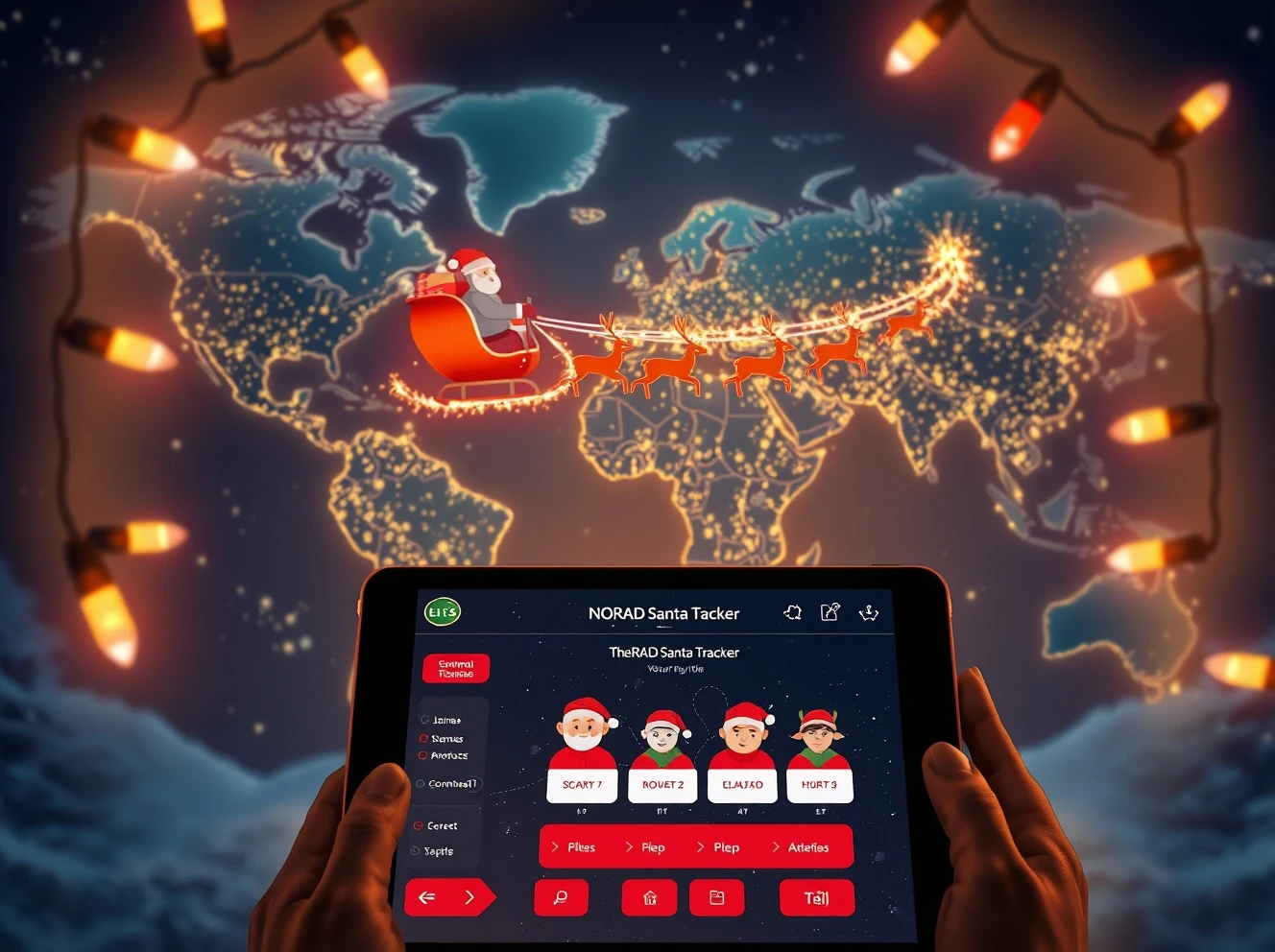
The platform’s core tracking interface utilizes Cesium’s 3D mapping technology alongside Bing Maps satellite imagery, creating a photorealistic globe showing Santa’s progress. Unlike earlier two-dimensional representations, this system provides altitude, speed, and directional data through an intuitive three-dimensional visualization. Volunteers at Peterson Space Force Base in Colorado Springs continue operating the program’s telephone hotline (1-877-HI-NORAD), answering approximately 130,000 calls annually from 200 countries.
NORAD’s 2025 AI features include three primary interactive tools:
- Elf Avatar Generator: This image transformation tool uses stable diffusion models to convert user-uploaded selfies into animated elf characters with holiday-themed accessories and backgrounds
- Toy Idea Generator: A large language model suggests creative toy concepts based on simple prompts, then converts these ideas into printable coloring book pages with appropriate complexity levels for different age groups
- Interactive Story Builder: This fill-in-the-blank narrative tool allows families to insert personal names, locations, and preferences into holiday stories, creating customized tales for reading aloud on Christmas Eve
The platform also maintains traditional elements that have delighted generations, including Santa Cam videos showing gift deliveries worldwide, the North Pole Village with educational games, and a holiday music library featuring international Christmas songs. NORAD provides the tracker through its website (available in eight languages), mobile applications for iOS and Android, and social media channels on Facebook, X (formerly Twitter), and Instagram.
| Feature Category | Specific Tools | Technology Used |
|---|---|---|
| Tracking Interface | 3D Global Map, Location Updates, Speed/Altitude Display | Cesium 3D, Bing Maps, Radar Simulation |
| AI Components | Elf Avatar, Toy Generator, Story Builder | OpenAI Models, Image Generation AI |
| Entertainment | Santa Cams, Games, Music Library, Videos | Video Streaming, Interactive Web Tools |
| Access Points | Website, Mobile Apps, Social Media, Phone Hotline | Multi-platform Development |
Google Santa Tracker: Search Giant’s Holiday Innovation
Google launched its Santa Tracker in 2004 as part of the company’s holiday tradition initiatives. The platform has evolved significantly over two decades, incorporating the company’s extensive mapping expertise and artificial intelligence capabilities. Unlike NORAD’s defense-oriented approach, Google’s system emphasizes educational content and interactive learning experiences alongside Santa tracking functionality.
The 2025 Google Santa Tracker operates as Santa’s Village throughout December, transitioning to live tracking on Christmas Eve. The platform features a detailed map showing Santa’s current location, next destination, estimated arrival times, delivered presents count, and total travel distance. Google integrates this data with its extensive geographic database, providing context about locations Santa visits during his journey.
Google’s educational components represent a distinctive approach to holiday content. The platform includes coding tutorials like “Code Boogie” that teach basic programming concepts through dance-themed puzzles. Geography games help children learn about world cultures and landmarks, while music creation tools like “Elf Jamband” introduce basic musical concepts. These elements demonstrate how holiday entertainment can deliver substantive learning experiences.
Google Assistant integration represents another significant AI component. Users can ask voice queries about Santa’s location, North Pole activities, or holiday traditions worldwide. The system responds with synthesized updates incorporating real-time tracking data, historical information, and festive sound effects. Google also produces daily North Pole Newscasts during December, featuring updates about Santa’s preparations and elf activities.
Comparative Analysis: NORAD vs. Google Approaches
While both platforms share the common goal of tracking Santa, their implementations reflect different organizational philosophies. NORAD emphasizes tradition and military precision, maintaining continuity with its 1955 origins while incorporating modern AI features. Google focuses on educational value and technological innovation, leveraging its search and mapping infrastructure to create learning opportunities. Both approaches successfully engage global audiences, with each platform attracting millions of visitors annually during the holiday season.
The Evolution of Santa Tracking Technology
Santa tracking technology has progressed through distinct phases since its 1955 inception. The telephone era (1955-1990s) relied on volunteer operators providing location updates based on simulated radar data. Early internet adoption (1997-2004) introduced basic websites with static maps and periodic updates. The interactive period (2005-2015) brought animated maps, games, and mobile applications. The current AI integration phase (2016-present) incorporates machine learning, natural language processing, and computer vision to create personalized, immersive experiences.
This technological evolution reflects broader trends in consumer digital experiences. Early tracking systems provided one-way information transmission, while modern platforms enable bidirectional interaction and content creation. The incorporation of AI specifically addresses growing expectations for personalized digital experiences across all consumer technology sectors. Holiday traditions like Santa tracking demonstrate how even longstanding customs adapt to technological possibilities.
Future developments may include augmented reality interfaces that project Santa’s sleigh into physical environments, blockchain-based gift tracking systems, or multilingual AI assistants that explain holiday traditions across cultures. These innovations will likely continue balancing technological sophistication with maintaining the simple wonder that makes Santa tracking meaningful for children worldwide.
Practical Implementation: How Families Use Santa Trackers
Families incorporate Santa tracking into Christmas Eve traditions in diverse ways. Many begin checking platforms during early evening hours as Santa departs the International Date Line. Parents often use the tracking tools to establish bedtime parameters, indicating that children should sleep before Santa reaches their region. Educational families leverage the geographic information to discuss time zones, international cultures, and holiday traditions worldwide.
The AI features specifically enable new interactive traditions. Families create elf avatars together, design custom coloring pages for holiday activities, or co-author personalized stories about Santa’s visit. These collaborative activities extend beyond passive observation to active participation in holiday magic creation. Child development specialists note that such interactive elements can enhance family bonding while developing children’s technological literacy.
Accessibility considerations remain important for these platforms. Both NORAD and Google provide multilingual interfaces, with NORAD offering eight language options and Google supporting dozens through translation tools. Mobile applications ensure access for families without desktop computers, while simplified interfaces accommodate users with varying technological familiarity. These inclusive design principles help ensure Santa tracking remains accessible to global audiences regardless of technical resources.
Conclusion
Santa tracker AI represents the harmonious integration of advanced technology with timeless holiday traditions. The 2025 platforms from NORAD and Google demonstrate how artificial intelligence can enhance rather than replace magical childhood experiences. These systems maintain the core wonder of Santa’s Christmas Eve journey while adding educational value, interactive engagement, and personalized content creation. As families worldwide prepare for December 24th, these AI-powered tools offer new ways to share holiday joy, learn about global geography, and create lasting memories. The evolution from telephone hotlines to sophisticated AI platforms shows how technology can preserve tradition while creating new possibilities for connection and wonder.
FAQs
Q1: How accurate are Santa tracker locations?
The locations represent simulated data based on time zone progression and traditional Santa lore rather than real-time surveillance. Both NORAD and Google create entertaining approximations of Santa’s journey for holiday enjoyment.
Q2: Are the AI features safe for children’s privacy?
Both platforms implement strong privacy protections. NORAD’s elf avatar generator processes images locally without permanent storage, while Google’s features operate within its standard privacy framework for children’s content. Neither platform requires personal identification for basic tracking functions.
Q3: What time does Santa tracking begin on Christmas Eve?
Live tracking typically commences at 6:00 AM EST on December 24th as Santa begins his journey from the International Date Line. Both platforms offer preparatory content throughout December before activating real-time tracking.
Q4: Do these trackers work outside North America?
Yes, both platforms provide global coverage. NORAD’s system tracks Santa’s journey across all continents, while Google’s mapping infrastructure includes worldwide location data. International users can access localized interfaces in multiple languages.
Q5: How have Santa trackers changed in the AI era?
Artificial intelligence has transformed passive observation into interactive experience. Modern platforms now offer personalized content creation, educational games with adaptive difficulty, voice interaction through digital assistants, and image generation tools that extend traditional tracking into creative holiday activities.